

If you need an office, you can take on conventional premises and organise much of the setup yourself, or choose a workspace where many of those practical details have already been handled.
That second option is where serviced offices come in.
A serviced office gives your business a ready-to-use workspace without requiring you to manage every aspect of the premises. That can make it a practical choice for growing companies, project teams and established businesses that want less property admin.
So, what is a serviced office, how does it work, and when might one suit your business?
What Is a Serviced Office?
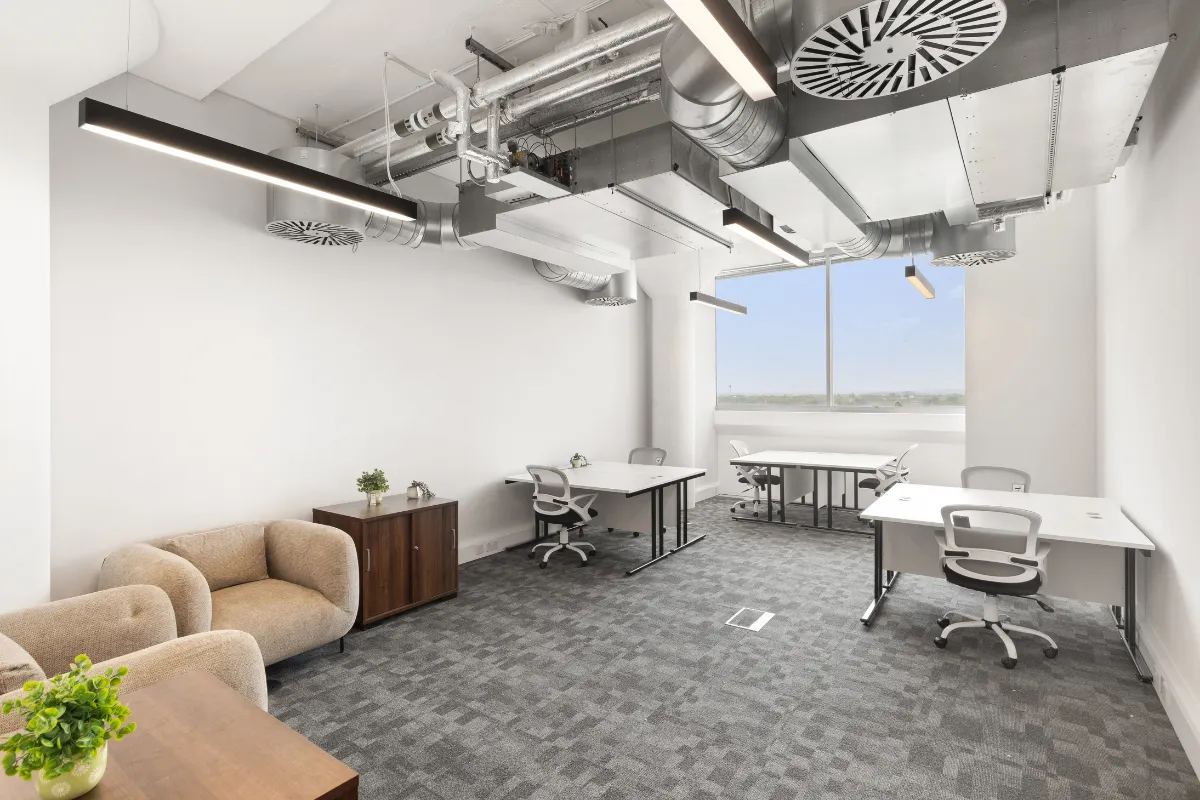
A serviced office is a furnished, professionally managed workspace that you rent from an office provider.
Government-backed guidance on finding business premises describes a serviced office as a furnished, managed workspace, usually with an area reserved exclusively for the occupier.
Instead of taking an empty commercial property and arranging everything yourself, you occupy an office where much of the essential infrastructure is already in place. The provider manages the building, while your team uses its own dedicated workspace.
Serviced offices are generally offered on more flexible terms than many traditional commercial leases. Depending on the building and provider, they can range from compact private offices to much larger spaces for established teams.
Exactly what is included varies, so it is important to check the individual agreement rather than assuming every serviced office works in the same way.
How Does a Serviced Office Work?
In practice, the provider handles much of the property setup and building management while you rent the workspace you need.
The process normally involves:
- Deciding how much space you need. Consider your current team and any likely growth.
- Choosing a suitable location. Think about commuting, public transport, and client access.
- Viewing available offices. Check whether the layout and building work for your team.
- Reviewing the agreement. Look at the term, notice arrangements, included services and additional charges.
- Moving in. Much of the basic workplace infrastructure should already be in place.
Some serviced offices use a standard layout, while others give businesses more scope to shape the space around their requirements.
At Purpose Group, our flexible workspaces can be tailored around different business requirements, with our in-house team available to help design and deliver a bespoke fit-out where appropriate.
Serviced Office vs Traditional Office
Both options give you a dedicated workplace, but responsibility for setting up and managing the space can differ considerably.
| Serviced office | Traditional leased office | |
| Setup | Usually prepared for occupation | May need furnishing and fit-out |
| Management | Provider manages much of the building | More responsibility may sit with you |
| Furniture | Commonly available | Often arranged separately |
| Terms | Generally more flexible | Often longer-term |
| Costs | Several costs may be combined | Costs are often handled separately |
These are typical differences rather than fixed rules. Services, responsibilities and contractual terms depend on the individual workspace and agreement.
A traditional lease can suit a business that wants greater long-term control over its premises.
A serviced office may make more sense when flexibility and simpler property management are higher priorities.
There is also a distinction between serviced and managed workspace. Our guide to the differences between managed and serviced offices explains how the two approaches compare.
Is a Serviced Office the Same as Coworking?
Not usually.
Coworking typically means working in a shared environment, often at a desk alongside people from other organisations.
A serviced office normally gives your business its own private office or dedicated workspace within a professionally managed building.
That can be useful if your team needs privacy for calls, meetings or confidential work while still benefiting from shared areas elsewhere in the building.
There can be some crossover between the two models, so if you are weighing up the options, our guide to the pros and cons of coworking looks more closely at shared workspace.
What Is Usually Included?
The precise package varies, but a serviced office may include:
- office furniture
- internet connectivity
- utilities
- building management
- cleaning of shared areas
- maintenance
- reception or on-site support
- shared meeting or breakout facilities
Some services may cost extra.
The Valuation Office Agency guidance on serviced offices notes that serviced-office charges can incorporate costs that might otherwise be dealt with separately, including items such as utilities, cleaning and building services.
That is why it is better to compare the full occupancy package rather than the headline monthly figure alone.
We will look at what is included in serviced offices in more depth in a separate guide, as this can vary significantly between operators and buildings.
What Are the Benefits of a Serviced Office?
For many businesses, the practical advantage is having fewer property-related tasks to manage.
Less Property Admin
A conventional office can involve arranging furniture, connectivity, utilities, maintenance, and other suppliers.
With a serviced office, much of that practical management sits with the provider.
This can reduce the number of separate property tasks your team needs to coordinate.
Greater Flexibility
Your headcount and working patterns can change during the time you occupy an office.
The CIPD defines flexible working as giving people flexibility over where, when, and the hours they work. For businesses using hybrid or flexible arrangements, that can influence how much permanent workspace they actually require.
Serviced offices can offer more room to adapt than some conventional lease structures, although the exact flexibility will always depend on your agreement and the availability of suitable space.
A Simpler Move
Because much of the basic setup is already handled, moving into a serviced office can involve fewer arrangements than fitting out an empty property.
That can be valuable when your priority is getting your team working rather than managing a separate office setup project.
Who Are Serviced Offices For?
Serviced offices are not only for start-ups.
They can suit:
- small businesses wanting a professional private workspace
- growing teams whose space requirements may change
- established companies setting up another office
- project teams needing dedicated space for a defined period
- businesses relocating and looking to reduce setup requirements
- larger organisations wanting private space without managing the entire property
Suitability depends more on your team, working pattern and plans for the space than on company size alone.
What Can a Serviced Office Look Like?
The amount of control you have over the layout and facilities varies between serviced-office providers and individual buildings.
Our Shipping Building in Hayes is one example from the Purpose Group portfolio.
Located within the Old Vinyl Factory in West London, it offers flexible offices for teams of different sizes, alongside meeting rooms, a staffed reception and custom fit-out options.
Wider on-site amenities include food and drink facilities, parking, and a gym and wellness suite.
It shows why choosing a serviced office involves more than counting desks. The building, location, facilities, and scope to configure the workspace can all influence whether it works for your team.
What Should You Check Before Choosing One?
Before signing an agreement, ask:
- What is included in the monthly price?
- Which services cost extra?
- What are the minimum term and notice arrangements?
- Is there enough space for the team to grow?
- Can you customise or brand the office?
- Are the meeting and shared facilities suitable?
- What building access arrangements apply?
- Is the location practical for your team?
Location deserves particular attention. Public transport, commuting patterns, nearby amenities and client access can all affect how well an office works in practice. Our guide to choosing the right office in London covers some of the factors worth weighing up.
Where possible, view the space before deciding.
A floor plan tells you how many desks fit. A viewing tells you whether those desks leave enough room to move, whether meeting rooms are practical, how much natural light reaches the office, and what the journey to the building actually feels like.
Those details can be difficult to judge from photographs alone.
Is a Serviced Office Right for Your Business?
A serviced office gives you a dedicated workplace without requiring you to manage every aspect of setting it up and running the building.
It can be a useful alternative to a conventional lease when you value flexibility, simpler occupancy and a professionally managed environment.
At Purpose Group, our office spaces vary by location and size, with options to tailor the workspace around your requirements.
If you are considering a serviced office for your next move, browse our available office spaces to see what is currently available across the Purpose Group portfolio.